
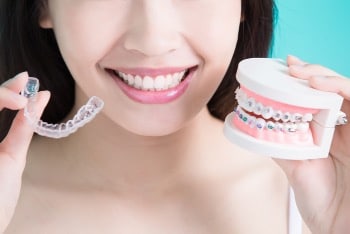
 Braces have long been a milestone that marks the changes from being a young child to a teenager. For decades, there was only 1 option – traditional metal braces. Innovative technology has changed how teeth are straightened, allowing for the use of clear aligners as well. Now that you have a choice between traditional braces and Invisalign clear aligner treatment, making a selection can prove challenging. You may want to know how both of these treatments work and how they compare before you can make an informed decision. Both types of treatment have benefits for patients. Parks Orthodontics shares the advantages and disadvantages so that you can decide what option is best for you!
Straightening Your Teeth with Invisalign
Invisalign treatment is a series of clear aligners that you wear over your teeth. Because the aligners are clear, hardly anyone will notice you are wearing them. Each tray is created to apply just enough pressure to encourage your teeth to move into the correct position. Your Invisalign aligners are only removed for eating, brushing and flossing. Dr. Parks will direct your treatment, and provide you with a schedule that explains when to change to new aligners and when to come to the office for appointments.
The Advantages of Invisalign
- The clear aligners are nearly undetectable
- No brackets, wires or roughness to irritate your mouth
- No dietary restrictions, since trays are removable
- Teeth remain easy to care for
- Follow-up appointments are fast
- Typically require fewer follow-up appointments
- Often provides faster results than traditional braces
The Disadvantages of Invisalign
- Removable trays can be misplaced
- Must be removed every time you eat or drink (except water)
- Must brush after each meal and every snack before reinserting the aligners
- Must be able to be responsible and remember to wear aligners consistently
Straightening Your Teeth with Traditional Braces
With traditional braces, metal or ceramic brackets are bonded to the front of your teeth. An archwire is threaded through the bracket, which is what helps to shift your teeth. Your orthodontist will typically adjust your braces every month, according to your treatment plan, encouraging your teeth to shift into the correct position.
The Advantages of Traditional Braces
- Effective for even the most complex treatment requirements
- No chance of misplacing because they are not removed
- No compliance issues, guaranteed to be worn
- Not removed for meals and snacks
The Disadvantages of Traditional Braces
- Brackets and wires may cause mouth irritation
- May be more difficult to care for teeth around the brackets and wires
- Braces need to be adjusted monthly
- You will need to avoid sticky, hard and chewy foods
Investing in the Health of Your Smile
While choosing your best treatment option can be difficult, there are many reasons to invest in the appearance and health of your smile. When you have a misaligned bite or crooked teeth, you are more susceptible to future health complications. Some of those complications include:
- Increased risk of cavities. Teeth that are not aligned can be difficult to clean
- Increased risk of periodontal disease when gums do not fit properly around a turned tooth
- A misaligned bite can cause jaw and facial pain
- Increased stress on the temporomandibular joint can cause arthritis
- An unhealthy smile will Increase your risk of inflammation and infection
- Inflammation causes heart disease and many other health conditions
Choosing either traditional braces or Invisalign clear aligners is a big decision. Our Pars Orthodontics treatment coordinator can help you understand the options recommended by Dr. Parks, and will guide you through your insurance benefits as well. We are happy to help! Schedule your complimentary consultation today!